Drive It In. Anchor Up. Move On.
By Lifegear Team
2026-07-06
Introduction: Why Large, Fast-Moving Sites Have Outgrown the Fixed Anchor Point
Walk a metro corridor under construction, a large-format plant turnaround, or a sprawling construction yard, and a pattern becomes obvious quickly: the work moves faster than any fixed anchor point can follow.
A tower or bolt-down anchor protects one location. On a site where the next task is 200 metres down the line tomorrow, and 200 metres further the day after, a fixed anchor means either installing a new one at every stop, or dragging equipment between zones with a crane, a forklift, and a crew standing by to manoeuvre it. Both options slow down a schedule that, on a metro or large-format construction site, is usually the one thing management can least afford to lose.
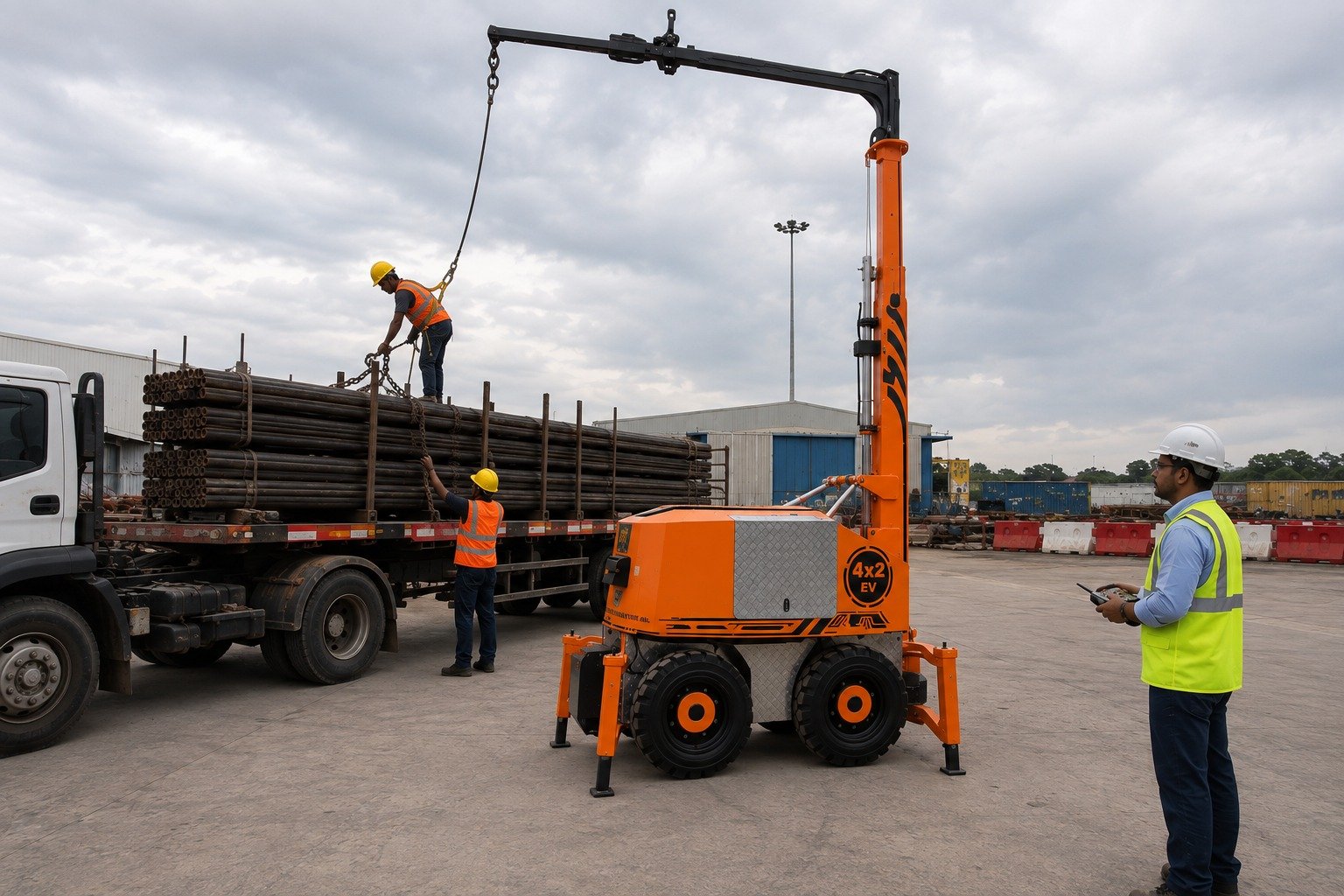
The Girafe On Wheels — G.O.W. — was engineered for exactly this category of site: one self-driven anchor platform that moves under its own power to wherever the work is, instead of waiting for the work to come to it.
1. The Problem With Anchors That Can't Move Themselves
A fixed anchor point, by definition, serves one location. When the task shifts, the anchor doesn't — the crew does, or the equipment gets repositioned manually, which on a large site usually means a crane, a forklift, or several people manhandling a unit across uneven ground.
That repositioning overhead is invisible in the spec sheet but very real in the schedule. Every relocation is dead time — time the anchor point isn't available anywhere, while it's between one location and the next.
On repeat-use sites — metro and rail corridors, construction yards, telecom and datacenter builds, chemical and pharma plants — that dead time compounds daily, across dozens of relocations over the life of a project.
2. What the Girafe On Wheels Actually Delivers
The Girafe On Wheels removes the manual relocation step entirely. It is a wheeled, self-driven anchor platform — no crane, no forklift, no manual dragging between work zones.
It drives itself into position under a choice of manual, gasoline, or EV power, giving sites the flexibility to match whatever power setup they already run. Skid steering, controlled wired or via Bluetooth, lets a single operator reposition the unit without a second person or a tow vehicle.
The hydraulic mast adjusts from 4 to 6 metres, matching dock-level, mezzanine-level, or rooftop-level work on the same unit, with a 2.2 m cantilever reach and a tested safe working load of 2.7–3 tonnes. When the job is done, the platform folds completely flat via a double hydraulic pack, for compact transport at roughly 1,250 kg and 2600×1550×2500 mm folded.
It's built for real terrain, too — rear-axle drive at 3–5 km/h, gradeability of 2–3, and solid rubber tyres, powered by a 24V 280Ah battery. Like the rest of the Girafe series, it's certified for both fall-arrest and rescue use under EN 795 Type C & D and CEN/TS 16415:2013.
3. Where It Is Already Working
The Girafe On Wheels has been deployed on metro and rail corridor projects, construction sites, telecom and datacenter yards, and chemical and pharma plants — the category of site where the anchor point genuinely needs to keep pace with the work, not the other way around.
Lifegear markets the EV-drive configuration of the G.O.W. as Asia's first and only mobile anchor point on EV — a distinction that matters for sites moving toward electrified equipment fleets and emissions-conscious operations.
4. The Case for an Anchor That Follows the Work
For a project planner running a metro corridor or a large-format construction site, the Girafe On Wheels replaces a recurring choice — install another fixed anchor, or pull a crane in to relocate the existing one — with a single unit that drives itself to the next zone and folds flat when it isn't needed.
That mobility doesn't come at the cost of certification. It's the same EN 795 Type C & D and CEN/TS 16415:2013 standard that governs every fixed anchor on site, just delivered on a platform that doesn't sit idle between locations.
For sites where the work outpaces fixed infrastructure, the Girafe On Wheels turns anchor-point coverage from a series of separate installations into one asset that moves with the project.
Conclusion
By eliminating manual towing and scaffolding delays, mobile EV fall protection platforms like the Girafe On Wheels streamline workflow agility while maintaining strict compliance. Adopting self-driven anchorage infrastructure allows large-scale projects to protect workers continuously without sacrificing speed or site mobility.
Ready to Take Action?
- Contact Lifegear for a Site Assessment of the Girafe On Wheels — www.lifegear.in
- Talk to Our Safety Engineers — Site assessment, model selection, and dispatch, in one call
- Learn More About ITRA Certification — www.technicalrescue.org
References & Further Reading
- Lifegear Safetech — Girafe On Wheels: www.lifegear.in
- ITRA: www.technicalrescue.org