Confined Space Rescue in Indian Industry: The Technical Realities Every Plant Head Must Know
By LifeGear Expert
2026-05-07
A confined space, in its regulatory and operational definition, is any enclosure large enough for a worker to enter and perform work, with limited means of entry and exit, and not designed for continuous occupancy. In the context of Indian heavy industry, this definition encompasses an enormous and varied range of work environments: storage tanks and process vessels in refineries, boilers and heat exchangers in power plants, reactors and columns in chemical complexes, silos in cement plants, sewage sumps and underground vaults in utilities, and the structural voids inside bridges and industrial structures. The number of confined space entries that occur daily across India's industrial sector runs into the thousands — and the associated rescue risk is correspondingly immense.
Yet despite this scale of exposure, the majority of Indian industrial sites do not maintain a rescue team that is specifically trained, equipped, and qualified for confined space rescue. The consequences are predictable. India's industrial fatality statistics consistently show confined space incidents among the top causes of worker death, and the pattern of secondary fatalities — rescuers dying alongside victims — is a recurring feature of these incidents. The technical requirements of confined space rescue are not intuitive, and they are not covered by standard fire or general safety training. They require dedicated expertise, dedicated equipment, and a documented rescue management system.
The Multi-Hazard Environment of Industrial Confined Spaces
What makes confined space rescue uniquely dangerous is the convergence of multiple, simultaneous hazards that do not typically coexist in open-space industrial environments. The primary hazard in most confined space incidents is atmospheric: oxygen deficiency, toxic gas accumulation (H2S, CO, SO2, ammonia), or the presence of flammable vapours. An oxygen-deficient atmosphere of 16% O2 — not far below the normal 21% — is sufficient to cause sudden incapacitation without warning. H2S at concentrations above 100 ppm can cause immediate loss of consciousness. A rescuer who enters such a space without SCBA is not performing a rescue — they are becoming the next casualty.
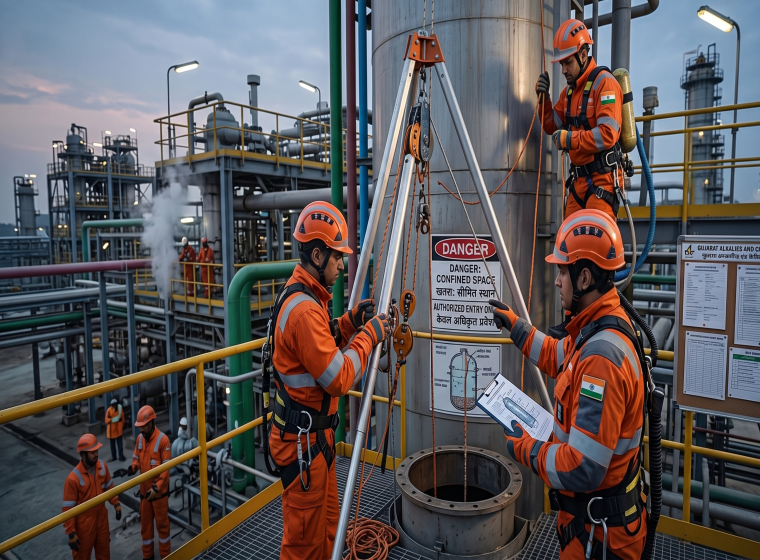
Beyond atmospheric hazards, confined spaces present physical hazards that require specialised rescue engineering. Engulfment hazards in grain silos and powder storage vessels can trap a victim in seconds. Structural hazards within process vessels — internal baffles, agitators, dip pipes — complicate patient access. Restricted entry geometry limits the equipment and techniques that can be deployed. In vertical confined spaces such as shafts and sumps, the retrieval of an incapacitated victim requires a properly rigged tripod or davit system with mechanical advantage — equipment that must be pre-staged at the entry point before work commences, not fetched from a store in the event of an emergency.
What a World-Class Confined Space Rescue Response Requires
ITRA-standard confined space rescue is built on a non-negotiable pre-entry rescue readiness framework. Before any confined space entry commences, the following must be in place: continuous atmospheric monitoring with a calibrated multi-gas detector covering O2, LEL, H2S, and CO at minimum; a fully equipped standby rescue team stationed at the entry point with SCBA, retrieval system, and first aid capability; a documented rescue plan specific to the space being entered; and a communications system between the entrant, the attendant, and the rescue team. The rescue plan must account for the dimensions of the space, the nature of the work, the known hazards, the rescue equipment available, and the emergency services contact protocol.
During a confined space rescue, the sequence of actions is precisely defined. Atmospheric monitoring continues throughout. If the entrant becomes incapacitated, non-entry retrieval using the tripod and harness system is the first response — no rescuer enters until atmospheric safety is confirmed. If entry rescue is necessary, SCBA-equipped rescuers enter in pairs with a belay line managed by a surface team member. Patient packaging — stabilising the victim in a drag stretcher or rescue stretcher — precedes extraction. Medical assessment begins the moment the victim reaches the surface. This sequence is not optional or approximate. It is the difference between a successful rescue and a multi-fatality incident.
ITRA Standards and the Lifegear Confined Space Rescue Capability
The International Technical Rescue Association (ITRA) sets the global benchmark for confined space rescue competency. ITRA-certified rescuers are assessed at three competency levels: Level 1 (Awareness and Operations), Level 2 (Technician), and Level 3 (Advanced Technician and Team Leader). Each level requires demonstrated practical proficiency — not just written knowledge — evaluated by ITRA-accredited assessors. In India, Lifegear Safetech and its affiliated training entity Pentasafe are the only providers offering ITRA-affiliated confined space rescue training and certification. Every Lifegear rescuer deployed to a client site carries ITRA certification appropriate to their assigned rescue role.
Lifegear's confined space rescue capability includes full-spectrum confined space rescue equipment inventories at each contract site, atmospheric monitoring protocols integrated into the RAP digital platform, pre-entry RSA (Rescue Site Assessment) conducted for every confined space work permit, and dedicated standby teams with SCBA during all confined space operations. The result is a rescue readiness standard that not only protects the workers entering the space — it protects the rescuers, the site, and the management team from the legal, regulatory, and reputational consequences of a preventable fatality. For plant heads and HSE managers in India's process industries, partnering with a ITRA-certified confined space rescue provider is no longer a best practice. It is a risk management imperative.
References & Further Reading
- Lifegear Safetech: https://www.lifegear.in
- ITRA Confined Space Standards: https://www.technicalrescue.org/
Ready to Take Action?
- Contact Lifegear for a Live Demo of RAP (Rescue Application Platform) — www.lifegear.in
- Inquire About Rescue Contracts — Permanent, Shutdown & Turnaround Rescue Coverage Across India
- Learn More About ITRA Certification — www.technicalrescue.org