Confined Space Rescue: Why an Entry Permit Alone Isn't Enough
By Lifegear Team
2026-11-18
Confined Space Rescue: Why an Entry Permit Alone Isn't Enough
A confined space entry permit is one of the most important documents on an industrial site. It confirms that the space has been isolated, ventilated and tested, and that the right people are authorised to enter.
But a permit controls entry. It doesn't guarantee rescue. If an entrant collapses inside a tank, sump or vessel, what happens in the next few minutes depends on whether a confined space rescue plan has been prepared, equipped and practised. This article explains the gap and how to close it.
The would-be rescuer problem
One of the most tragic patterns in confined space incidents is the would-be rescuer. A worker collapses inside a space. A colleague sees it and goes in to help without breathing apparatus or a retrieval line, and is overcome by the same atmosphere.
This happens because people act on instinct when a colleague is in trouble. The only reliable way to prevent it is to make sure that a trained team, with the right equipment, is already in place and that everyone else knows not to enter.
What a permit covers, and what it doesn't
| A permit typically confirms | A permit does not by itself provide | |---|---| | Isolation of energy, process lines and moving parts | A trained rescue team at the entry point | | Ventilation and atmospheric testing before entry | Retrieval equipment set up and ready | | Authorised entrants and an attendant | A tested way to raise the alarm | | PPE and equipment requirements | A rescue method written for this specific space | | Time limits and conditions of entry | Proof that the rescue can actually be carried out |
The permit should refer to the rescue plan, and the person issuing it should confirm that rescue arrangements are in place before signing.
5 parts of a confined space rescue plan
1. A rescue method for this specific space
Every confined space is different. A vertical manhole into a sump needs a different method from a side manway into a horizontal vessel. The plan should state how the casualty will be reached, secured and removed from this particular space, considering the opening size, depth, internal obstructions and likely position of a casualty.
2. Retrieval equipment, set up before entry
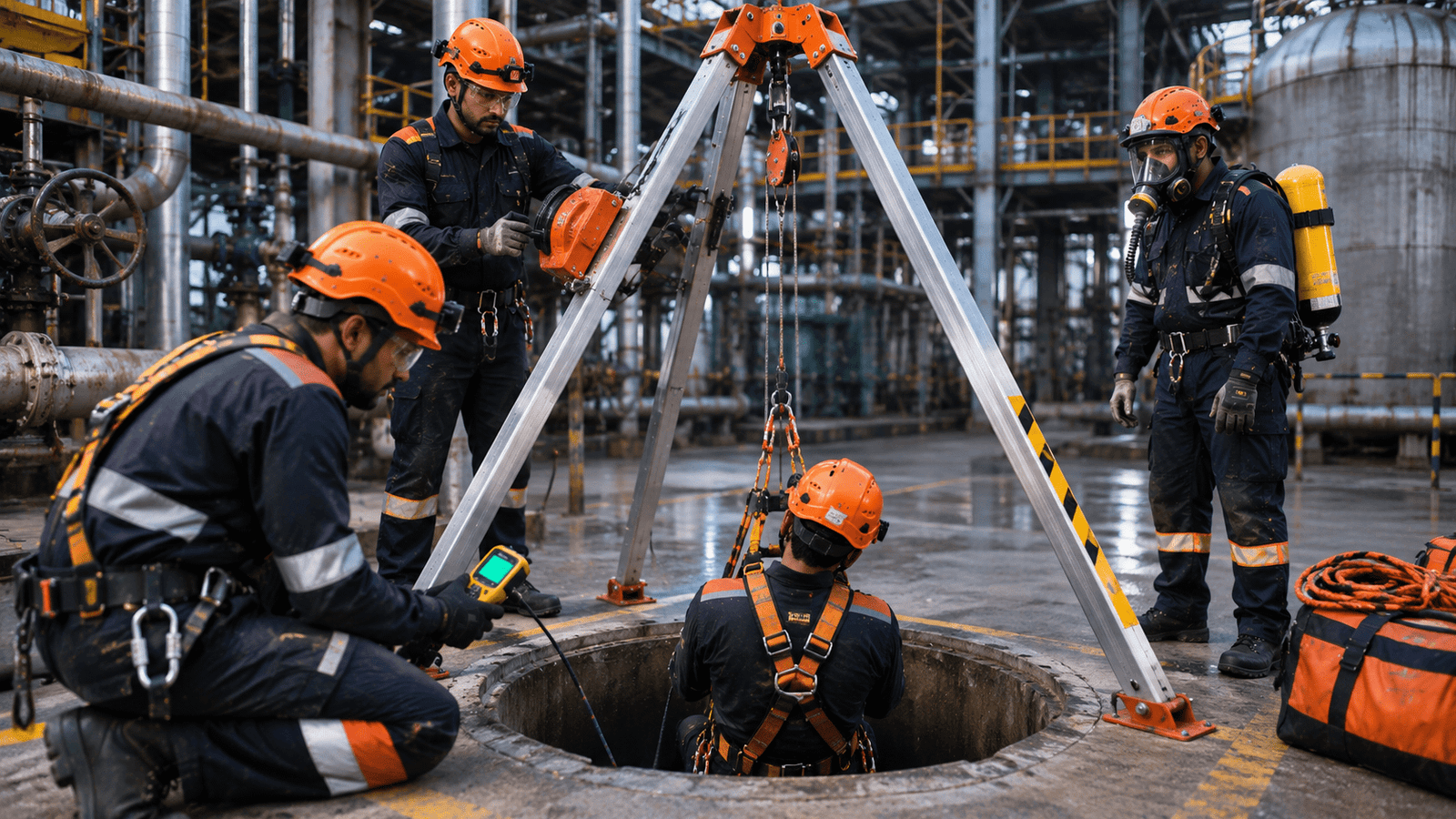
Where possible, entrants should be attached to a retrieval system so they can be pulled out without anyone entering. For vertical entries, this is often a tripod or davit with a winch or retrieval device. The equipment should be in position and connected before the first person enters, not stored somewhere else on site.
3. Continuous atmospheric monitoring
Conditions inside a space can change after the initial test, especially if work such as cleaning, welding or coating is taking place. Continuous monitoring during entry gives early warning if oxygen levels drop or toxic or flammable gases build up.
4. A trained standby rescue team
The attendant at the entry point should never enter the space to perform a rescue. Instead, a trained rescue team with breathing apparatus and rescue equipment should be close enough to begin rescue immediately. Their competency should match the complexity of the space.
5. Communication and drills
Agree how the entrant, attendant and rescue team will communicate, and how the alarm will be raised. Then practise the rescue on the actual space, or one like it, before the job begins. A drill is the only way to find out whether the stretcher fits through the manway or whether the radio works inside the vessel.
Non-entry rescue vs entry rescue
Non-entry rescue means removing the casualty without anyone entering the space, usually by using the retrieval line already attached to the entrant. It is the safest option and should be planned for wherever the space allows.
Entry rescue is needed when non-entry rescue is not possible, for example when internal obstructions would snag the retrieval line, or when the casualty is not attached. Entry rescue must be done only by trained rescuers with suitable respiratory protection and equipment.
A good confined space rescue plan states which method will be used first and what happens if it fails.
Gas detection before and during entry
Atmospheric hazards are the main reason confined spaces are so dangerous. Gas detection should:
- Test for oxygen, flammable gases and the toxic gases relevant to the process.
- Test at different levels within the space, because some gases are heavier or lighter than air.
- Continue throughout the entry, not stop after the first reading.
- Use detectors that are calibrated and bump-tested according to the manufacturer's instructions.
If readings change during entry, the entrant should leave immediately, and the cause should be found before re-entry.
How Lifegear supports confined space rescue
Lifegear provides standby rescue teams for confined space entry, along with rescue site assessment and planning, rescue equipment and gas detection services, including equipment rental, sales, inspection and calibration. Our rescuers work to a defined skill structure, explained in our article on Responder, Technician and Advanced rescue skill levels.
If you are choosing a provider, our buyer's checklist for industrial rescue services lists the questions to ask.
Frequently asked questions
What is confined space rescue?
Confined space rescue is the process of removing an injured, ill or trapped person from a confined space such as a tank, vessel, silo, sump or pit, using trained rescuers and suitable equipment.
Can the confined space attendant perform the rescue?
The attendant should not enter the space. Their role is to monitor the entrants, maintain communication, raise the alarm and, where a retrieval system is fitted, start a non-entry rescue.
What equipment is needed for confined space rescue?
Typical equipment includes a tripod or davit with a retrieval winch, full body harnesses, gas detectors, breathing apparatus, communication equipment and a stretcher suitable for the space.
How often should confined space rescue drills be done?
Drills should be done before high-risk entries and at regular intervals set by your site procedures, and whenever the space, equipment or team changes significantly.
Why are gas readings taken at different levels?
Some gases are heavier than air and collect near the bottom, while others are lighter and collect near the top. Testing at several levels gives a truer picture of the atmosphere.
Make your confined space rescue plan work in practice
Lifegear can assess your confined spaces, write task-specific rescue plans and provide trained standby rescue teams. Contact our team to discuss your next entry or shutdown.