Fall Arrest vs Fall Restraint vs Work Positioning: What's the Difference?
By Lifegear Team
2026-11-25
Fall Arrest vs Fall Restraint vs Work Positioning: What's the Difference?
Three workers on the same site might all be wearing a full body harness. One is protected by fall restraint, one by fall arrest and one is in work positioning. From a distance they look the same. In practice, they are protected in completely different ways, and the wrong choice can leave a worker exposed.
This article explains fall arrest vs fall restraint, where work positioning fits, and how to choose the right system for a task.
The short answer
- Fall restraint stops a worker from reaching the place where they could fall.
- Fall arrest stops a worker after they have started to fall.
- Work positioning supports a worker at the work position so they can use both hands, and must be backed up by fall arrest.
Fall restraint
A fall restraint system keeps the worker tethered so they physically cannot reach an unprotected edge, opening or fragile surface. If set up correctly, no fall happens at all.
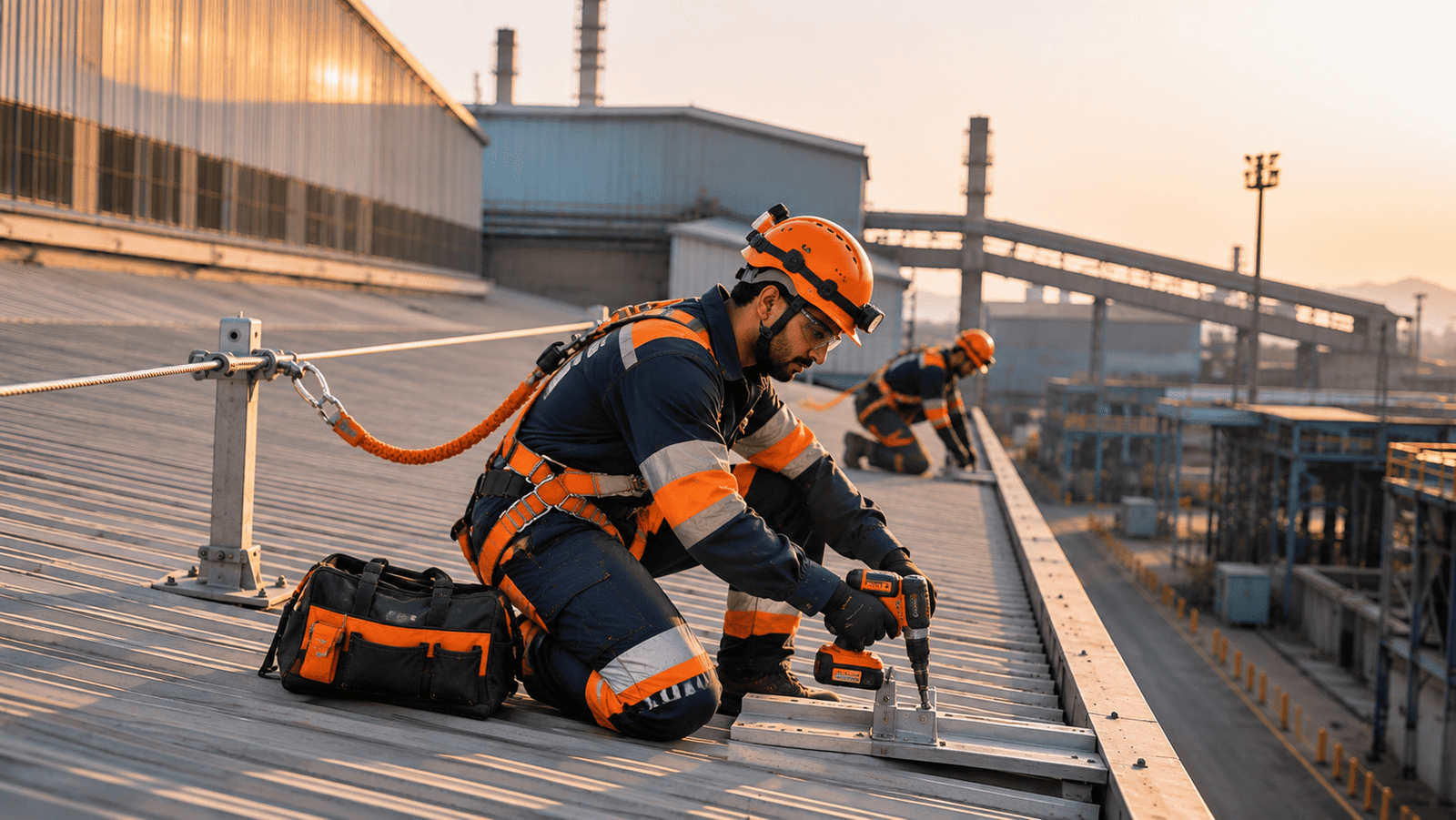
Typical example: a worker on a flat roof is connected to an anchor or horizontal lifeline by a lanyard short enough that they cannot reach the roof edge.
Why it matters: because no fall occurs, there is no fall impact and no need to rescue a suspended worker. Wherever the task allows, restraint is preferred over arrest.
Watch for: the lanyard length and anchor position must be set so the edge is truly out of reach from every point the worker can move to. Adjustable lanyards must be set correctly and not lengthened during work.
Fall arrest
A fall arrest system allows a fall to start but stops it safely before the worker hits the ground or a lower level. It usually includes:
- A full body harness.
- A connecting device, such as an energy-absorbing lanyard or a self-retracting lifeline.
- A suitable anchor point or anchor system.
Typical example: a worker on a steel structure is connected by a twin energy-absorbing lanyard to a horizontal lifeline above them.
Why it matters: fall arrest protects workers where a fall cannot be prevented, such as on open structures or near edges they must reach.
Watch for: fall arrest needs enough fall clearance below the worker, and it always needs a rescue plan, because the worker will be left suspended after the fall.
Work positioning
A work positioning system supports the worker at height so they can lean back and work with both hands, for example on a pole, column or tower. It typically uses a positioning lanyard connected to the side D-rings of the harness.
Typical example: a worker on a vertical steel column wraps a positioning lanyard around the column, then clips it to both side D-rings, and also connects a separate fall arrest lanyard to an anchor above.
Why it matters: it allows work that would otherwise be very tiring or unsafe while hanging on with one hand.
Watch for: work positioning is not fall arrest. It should be used together with a separate fall arrest system unless a competent person has confirmed that the arrangement prevents any free fall.
Side-by-side comparison
| | Fall restraint | Fall arrest | Work positioning | |---|---|---|---| | Purpose | Prevents reaching the fall hazard | Stops a fall in progress | Supports the worker at the work position | | Does a fall occur? | No | Yes, then it is stopped | Should not, but backup is required | | Harness connection | Usually back or front D-ring | Back or front fall-arrest D-ring | Side D-rings, plus fall arrest backup | | Fall clearance needed? | No (if set correctly) | Yes | Yes, for the backup system | | Rescue plan needed? | Recommended | Essential | Essential | | Typical use | Flat roofs, platforms with open edges | Structures, ladders, lifelines | Poles, columns, towers, rebar walls |
Fall clearance, explained simply
Fall clearance is the vertical space needed below a worker so that a fall arrest system can stop them before they hit anything. It is made up of several parts added together:
- The free fall distance before the system starts to work.
- The extra distance the energy absorber needs to deploy.
- Stretch in the harness and movement of the D-ring.
- The height of the worker below the D-ring.
- A safety margin.
If the clearance below is not enough, the worker may hit the ground or a lower structure even though the system works perfectly. Always use the clearance figures provided by the equipment manufacturer for the exact combination being used, and keep anchors above the D-ring wherever possible to reduce free fall.
Choosing the right system for the task
Ask these questions in order:
- Can a fall be prevented altogether? Use guardrails, platforms or fall restraint.
- Does the worker need to reach the edge? If yes, fall arrest is likely needed.
- Does the worker need both hands free while supported? Add work positioning, with fall arrest as backup.
- Is there enough clearance below? If not, consider a self-retracting lifeline, a higher anchor or restraint instead.
- How will the worker be rescued? Every fall arrest or work positioning task needs a rescue plan.
Where anchors fit in
All three systems depend on a suitable anchor. Lifegear engineers anchor and lifeline solutions for different site conditions, including the Girafe series of portable anchor systems and horizontal and vertical lifeline systems. Our article on fall protection engineering and rescue services explains how these fit alongside rescue capability. For a task-by-task list of checks, see our working at height safety checklist.
Frequently asked questions
What is the main difference between fall arrest and fall restraint?
Fall restraint prevents the worker from reaching a fall hazard, so no fall occurs. Fall arrest allows a fall to begin and stops it safely.
Is fall restraint safer than fall arrest?
Where the task allows it, fall restraint is generally preferred because no fall happens, so there is no impact force and no suspended worker to rescue.
Can a work positioning lanyard be used for fall arrest?
No. A work positioning lanyard is designed to support a worker, not to stop a fall. A separate fall arrest system should be used as backup.
What is fall clearance?
Fall clearance is the minimum clear space needed below a worker so a fall arrest system can stop the fall before the worker strikes the ground or an obstruction.
Which D-ring is used for fall arrest?
Fall arrest connections are normally made to the D-ring marked for fall arrest on the back, or on the front where the harness is designed for it. Always follow the harness manufacturer's markings and instructions.
Get the right fall protection for your site
Lifegear can assess your tasks and recommend restraint, arrest or positioning solutions engineered for your structures. Contact our team.