Fire & Smoke Detection in Real Time: How Edge AI Is Changing Plant Safety
By Lifegear Team
2026-05-06
Introduction: Why Conventional Fire Detection Can Be Too Slow for Industrial Environments
By the time a conventional smoke alarm triggers in many industrial facilities, a fire may have already established itself.
Traditional smoke detectors generally depend on particulate concentration reaching a predefined threshold. In large industrial spaces, high-ceiling warehouses, foundries, smelters, chemical plants, and manufacturing facilities, that process can take valuable time — especially where smoke needs to travel from the source to a physically installed detector.
AI video analytics approach the problem differently.
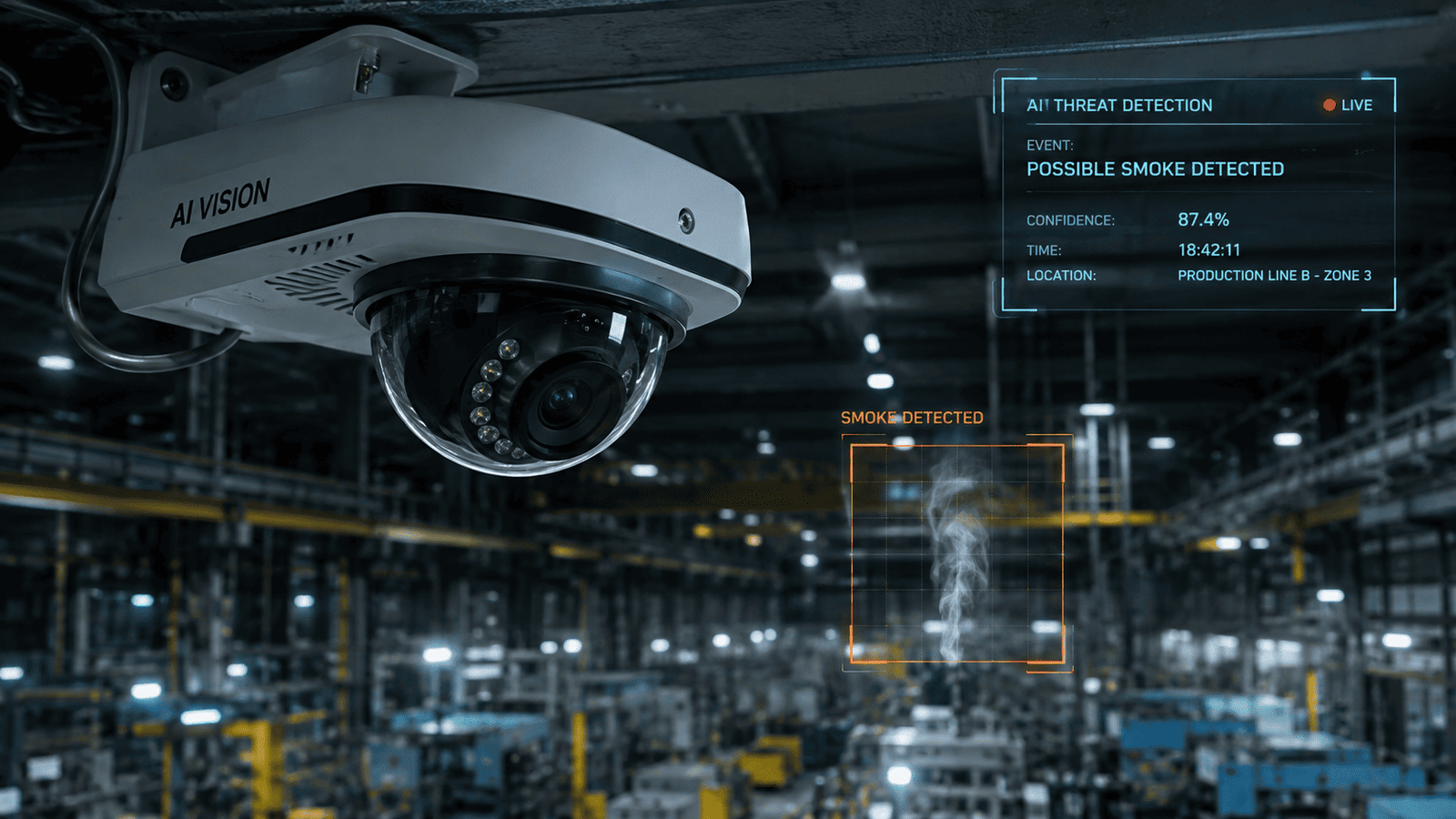
Instead of waiting for smoke particles to reach a sensor, camera-based AI can continuously analyse the visual environment and identify smoke and flame signatures as they appear. When that processing happens directly at the edge, detection does not have to depend on sending every video frame to the cloud and waiting for a response.
Lifegear's RASU is designed around this principle: use intelligent video analytics to detect fire and smoke in real time, then immediately communicate the alert through multiple channels so the response can begin without unnecessary delay.
1. The Problem With Waiting for Conventional Detection
A conventional smoke detector can only respond once smoke reaches the detector and crosses its configured threshold.
That works well for many controlled indoor environments, but industrial facilities introduce additional challenges. Large floor areas, high ceilings, machinery, ventilation systems, dust, heat, and constantly changing operating conditions can make traditional detection slower or more difficult.
In these environments, the first visible signs of smoke or flame can appear before conventional sensors register a sufficient particulate concentration.
That gap matters.
A fire that is identified while it is still developing may be isolated, investigated, and controlled before it spreads to surrounding equipment or materials. A fire detected several minutes later may already require a significantly larger emergency response.
The objective, therefore, is not simply to detect fire — it is to detect the earliest meaningful visual indication of fire or smoke.
2. What Edge AI Fire & Smoke Detection Actually Delivers
Edge AI changes where the detection intelligence operates.
Instead of continuously sending camera footage to a remote cloud platform for analysis, edge-based systems process video closer to the camera or within the local industrial environment. AI models can analyse the live feed and identify visual patterns associated with smoke and flames in real time.
This creates a faster detection loop:
Camera → Edge AI Analysis → Fire/Smoke Detection → Instant Alert → Response
Lifegear's RASU uses AI-powered video analytics to monitor industrial environments for fire and smoke signatures. When a potential event is identified, the system can trigger immediate alerts through multiple communication channels, including SOS alarms, WhatsApp, and SMS.
The result is a detection and notification system designed to compress the gap between the first visible indication of an incident and the people responsible for responding to it.
3. Why Edge Processing Matters When the Network Doesn't
Industrial connectivity cannot always be assumed to be perfect.
Large plants, warehouses, construction environments, and remote industrial areas can have network dead zones, unstable Wi-Fi, LAN interruptions, or limited connectivity between different sections of a facility.
A cloud-dependent detection architecture introduces another potential dependency: the video must reach the cloud before the analytics can make a decision.
Edge processing reduces that dependency by performing the core video analysis locally.
The detection system can therefore continue analysing the camera feed even when external connectivity is interrupted, while the communication layer can use whatever alerting and connectivity options are available to notify the appropriate personnel.
For safety-critical monitoring, that resilience is not simply a technical advantage. It is part of maintaining continuous situational awareness across the plant.
4. Where Real-Time AI Fire Detection Makes the Most Sense
The value of early visual detection becomes particularly clear in environments where a developing fire can quickly create significant operational, financial, or safety consequences.
Typical applications include:
- Foundries and smelters
- Chemical and pharmaceutical plants
- Manufacturing facilities
- Large warehouses
- Storage and logistics facilities
- Industrial production areas
- High-risk machinery zones
- Large-format plants and process areas
In these environments, AI video analytics can provide an additional layer of protection by continuously watching areas where conventional detection alone may not provide the earliest possible indication.
The goal is not necessarily to replace every existing fire detection technology. Instead, AI-based visual detection can complement established safety infrastructure by adding another method of identifying an incident at its earliest visible stage.
5. From Detection to Response in Seconds
Detecting a fire is only the first step.
The real safety advantage comes from what happens immediately after detection.
If an AI system identifies smoke or flame but the alert reaches the responsible team several minutes later, much of the potential advantage of early detection is lost.
That is why real-time detection needs to be paired with real-time communication.
With multi-channel alerting such as SOS alarms, WhatsApp, and SMS, a detected event can be communicated simultaneously to the people responsible for plant safety and emergency response.
This shortens the chain from:
Visual indication → Detection → Notification → Human response
Every second removed from that chain can improve the opportunity to investigate, isolate equipment, evacuate personnel, or initiate the appropriate emergency procedure before the situation escalates.
Conclusion
Fire detection in industrial environments is ultimately a race against time.
Conventional detectors remain an important part of fire safety infrastructure, but they depend on smoke or particulate concentration reaching a physical sensor before an alarm can be triggered. AI video analytics introduce another approach — continuously observing the environment and identifying visible smoke and flame signatures as they emerge.
By processing video at the edge, systems such as Lifegear's RASU can reduce dependence on cloud round-trips while maintaining real-time analysis closer to the point of detection.
When that detection is combined with instant multi-channel alerting, industrial teams gain a faster path from the first visual indication of an incident to an actionable response.
For facilities where seconds can determine whether a fire remains contained or becomes a major industrial event, edge AI turns fire detection from a threshold-based reaction into a continuous, intelligent layer of plant safety.
Ready to Take Action?
- See RASU's Fire & Smoke Detection in Action — Request a Demo
- Talk to Our Safety Engineers — Discuss your plant environment, camera coverage, detection requirements, and deployment options
- Explore AI-Powered Industrial Safety — Learn how real-time video analytics can complement your existing safety infrastructure
References & Further Reading
- Lifegear Safetech — RASU AI Safety Systems: www.lifegear.in
- Lifegear — Contact & Demo Request: lifegear.in/contact