RASU: Meet India's First Standalone AI Safety Supervisor
By Lifegear Team
2026-08-22
Introduction: Why Industrial Safety Needs More Than Human Eyes
Industrial safety has always depended heavily on human attention.
Supervisors walk through production floors, inspect work areas, check PPE compliance, monitor hazardous activities, and respond when something goes wrong. But even the most experienced safety team has one unavoidable limitation: people cannot watch everything, everywhere, all the time.
Fatigue, shift changes, blind spots, large operating areas, temporary work zones, and rapidly changing site conditions can all create gaps in safety monitoring.
That is where RASU — Robot As a Supervisor — comes in.
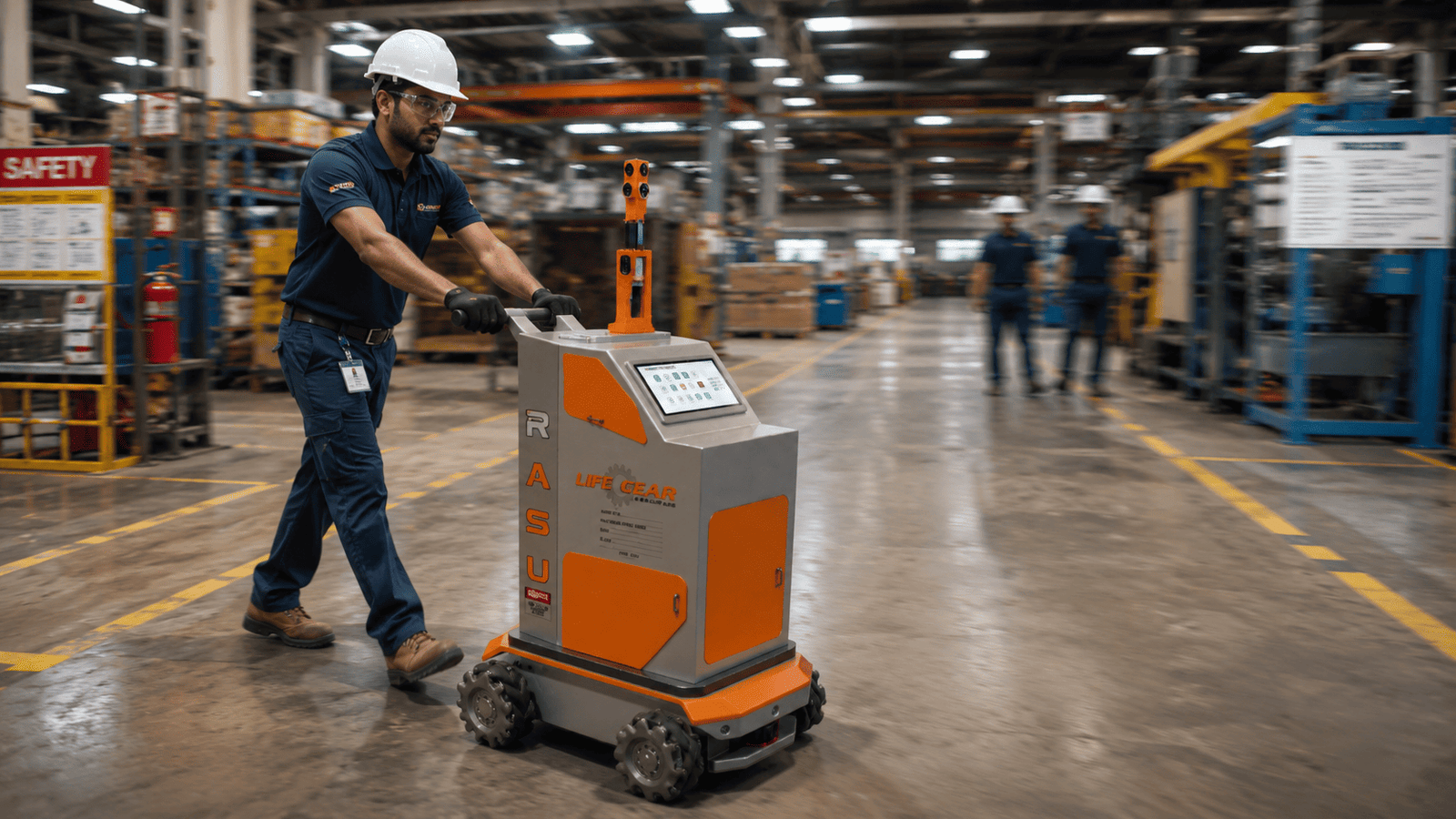
Developed by Lifegear, RASU is a standalone, portable AI safety machine designed to provide continuous visual and audio-based safety monitoring across industrial environments.
With 320° surveillance, real-time fire and smoke detection, PPE compliance monitoring, multilingual voice intervention, automatic SOS alarms, and instant digital alerts, RASU acts as a tireless second set of eyes for industrial safety teams.
It does not replace human safety supervisors.
It extends their reach.
1. The Problem With Conventional Safety Surveillance
Traditional industrial surveillance is largely built around fixed CCTV cameras.
They are useful, but their biggest strength is also their biggest limitation: they stay where they are installed.
A camera mounted in one production area cannot suddenly move to a shutdown zone.
A camera covering a permanent production line may not provide useful visibility during a temporary maintenance activity.
And when a large facility undergoes a turnaround, expansion, construction activity, or equipment relocation, the existing camera infrastructure may not cover every new risk area.
This creates a familiar challenge for safety teams:
The work moves. The risks move. The cameras don't.
Human supervisors can physically move between locations, but they cannot maintain continuous visibility across an entire facility.
RASU addresses this gap by bringing AI-powered safety monitoring to the location where it is needed.
Instead of building permanent surveillance infrastructure for every temporary or changing work zone, RASU can be repositioned across the facility as site conditions change.
2. What RASU Actually Delivers
RASU is designed as a portable, wheeled AI safety supervisor that can operate across industrial environments without being tied to a single fixed surveillance point.
Its core capabilities combine AI-powered video analytics, audio analytics, mobility, and automated communication.
The result is a system that can do more than simply record video.
RASU can:
- Monitor industrial areas through 320° surveillance
- Detect fire and smoke in real time
- Identify PPE non-compliance
- Monitor safety conditions continuously
- Provide immediate voice intervention
- Communicate warnings in local languages
- Trigger automatic SOS alarms
- Send alerts through WhatsApp
- Send safety notifications through Email
- Integrate with CMMS platforms
- Move between different work zones
- Operate as an additional layer of safety supervision
This changes the role of surveillance from passive observation to active safety intervention.
3. RASU Doesn't Just Watch — It Responds
One of the biggest differences between conventional CCTV and an AI safety supervisor is what happens after an unsafe condition is detected.
A conventional camera records an event.
Someone may need to watch the footage.
Someone may need to identify the violation.
Someone then needs to communicate with the worker or supervisor.
RASU is designed to shorten that chain.
When the AI identifies a relevant safety event, the system can respond immediately through voice intervention and digital alerts.
For example, if a worker enters a monitored area without the required PPE, RASU can identify the non-compliance and issue an immediate voice warning.
If smoke or fire is detected, the system can initiate an alert response and notify designated personnel.
This creates a much faster feedback loop:
Detect → Analyse → Warn → Alert → Respond
Instead of relying entirely on someone noticing an event after it happens, RASU is designed to intervene at the point where the event is detected.
4. AI-Powered PPE Compliance Monitoring
Personal protective equipment remains one of the most visible indicators of workplace safety compliance.
Helmets, safety vests, protective equipment, and other required PPE are often mandatory in designated industrial areas.
But maintaining continuous manual PPE checks across a large facility is difficult.
A safety supervisor may inspect a particular area at 10:00 AM.
The same area may look completely different at 11:00 AM.
RASU provides continuous AI-assisted monitoring of designated areas, helping safety teams identify PPE-related non-compliance as it occurs.
Rather than replacing safety inspections, the system provides another layer of continuous observation.
This can be particularly useful in:
- Manufacturing plants
- Construction sites
- Infrastructure projects
- Warehouses
- Logistics facilities
- Shutdown and turnaround projects
- Industrial maintenance zones
- Temporary work areas
- High-risk operating environments
The objective is simple:
Make safety visibility continuous, not occasional.
5. Real-Time Fire and Smoke Detection
Fire and smoke can develop rapidly.
In large industrial environments, early detection can make a critical difference in how quickly a response begins.
RASU combines AI-powered visual monitoring with continuous surveillance to identify fire and smoke conditions within monitored areas.
Instead of depending solely on a person noticing smoke from a distance or reviewing recorded footage later, RASU is designed to detect relevant visual conditions in real time and initiate an alert response.
This makes the platform particularly relevant for environments where temporary or changing work areas need additional monitoring.
Potential applications include:
- Industrial plants
- Construction sites
- Warehouses
- Maintenance areas
- Shutdown zones
- Temporary project areas
- Equipment yards
- Large-format facilities
RASU adds an intelligent monitoring layer that can complement existing fire detection and emergency response systems.
6. 320° Surveillance for Wider Site Visibility
Industrial environments rarely fit neatly inside the field of view of a single fixed camera.
Machinery, structures, temporary equipment, storage areas, and moving personnel can create multiple visual obstructions and monitoring challenges.
RASU provides up to 320° surveillance coverage, giving the system a wide monitoring perspective from a single mobile platform.
Combined with its ability to move between work zones, this allows safety teams to position AI-based monitoring closer to where work is actually taking place.
The value isn't simply the number of degrees.
It is the combination of:
Wide visibility + mobility + AI analytics + automated response.
That combination makes RASU fundamentally different from simply adding another fixed camera to a facility.
7. Multilingual Voice Intervention
Detecting a safety violation is only part of the problem.
The worker also needs to know that a violation has occurred.
RASU is designed to provide immediate voice intervention, including communication in local languages.
This allows the system to move beyond silent monitoring.
Instead of waiting for a supervisor to physically reach the location, RASU can provide an immediate audible warning when a relevant safety condition is identified.
For large industrial workforces with employees from different linguistic backgrounds, multilingual intervention can make safety communication more direct and accessible.
The system becomes an active participant in the safety environment rather than simply an observer.
8. Mobile Safety Monitoring Where Fixed CCTV Can't Reach
The industrial workplace is constantly changing.
Shutdowns move from one section of a plant to another.
Construction activities progress across a site.
Maintenance teams move between equipment.
Temporary work zones appear and disappear.
New hazards can emerge in locations that were not part of the original surveillance plan.
This is where RASU's mobility becomes important.
Because it is a portable, wheeled platform, RASU can be repositioned according to operational requirements.
That makes it particularly suited to environments where permanent surveillance infrastructure is impractical, expensive, or simply too slow to adapt.
Instead of asking:
"Where should we install another camera?"
Safety teams can ask:
"Where should RASU go next?"
9. RASU for Shutdowns, Turnarounds and High-Risk Work
Shutdown and turnaround activities can dramatically change the safety profile of an industrial facility.
Normal production stops.
Maintenance teams enter previously restricted areas.
Contractors increase.
Scaffolding, temporary equipment, welding, hot work, lifting operations, and other activities can happen simultaneously.
The result is a dynamic environment with constantly changing safety requirements.
RASU can provide an additional layer of AI-powered monitoring during these temporary high-risk periods.
Because the platform can be repositioned, it can follow the work as activities move from one area to another.
This makes RASU particularly relevant for:
- Plant shutdowns
- Turnaround projects
- Maintenance campaigns
- Construction activities
- Temporary work zones
- High-risk maintenance areas
- Infrastructure projects
For safety teams, this means additional monitoring capability without requiring permanent camera infrastructure for every temporary activity.
10. Alerts That Connect Safety Events to the Digital Workflow
Modern safety management does not stop at detecting an incident.
The event needs to reach the right people.
RASU can push alerts through multiple communication channels, including:
- CMMS integrations
This allows safety events to move from physical detection into the organisation's digital workflow.
A detected event can therefore become a notification that reaches the appropriate safety, maintenance, or operational team.
The objective is to reduce the gap between:
Something happened
and
Someone responsible knows about it.
When combined with automated SOS functionality, this creates a more connected safety response system.
11. RASU vs Fixed CCTV
Fixed CCTV remains an important part of industrial security and safety infrastructure.
RASU is not designed to eliminate it.
Instead, it addresses a different requirement.
| Capability | Fixed CCTV | RASU | |---|---|---| | Permanent monitoring location | Yes | No | | Mobile deployment | No | Yes | | AI-powered safety analytics | Depends on system | Yes | | PPE detection | Depends on system | Yes | | Fire and smoke detection | Depends on system | Yes | | Voice intervention | Generally limited | Yes | | Multilingual intervention | Generally limited | Yes | | 320° surveillance | Depends on camera | Yes | | WhatsApp alerts | Depends on integration | Yes | | Email alerts | Depends on integration | Yes | | CMMS integration | Depends on system | Yes | | Temporary work-zone deployment | Limited | Yes | | Shutdown/turnaround mobility | Limited | Yes |
The strongest approach for many industrial environments may therefore not be CCTV versus RASU.
It may be:
CCTV + RASU + Human Safety Teams.
Each layer addresses a different part of the safety challenge.
12. The Human Supervisor Still Matters
The name "Robot as a Supervisor" does not mean replacing the people responsible for workplace safety.
Industrial safety requires experience, judgement, communication, investigation, training, emergency management, and leadership.
Those responsibilities remain human.
RASU is designed to support those teams by providing continuous monitoring where human attention cannot always be present.
Think of it as an additional safety resource:
A supervisor can watch many things.
RASU can keep watching when the supervisor has to move somewhere else.
That makes the technology particularly valuable for facilities operating with lean safety teams or large geographic areas.
13. Where RASU Fits Best
RASU can be deployed wherever safety monitoring needs to be mobile, continuous, and intelligent.
Potential applications include:
Manufacturing Plants
Monitor production areas, maintenance zones, and changing operational environments.
Construction Sites
Provide AI-assisted monitoring across temporary work areas as construction progresses.
Infrastructure Projects
Follow work across large and constantly changing project environments.
Warehouses and Logistics
Monitor personnel movement, PPE compliance, and safety conditions across operational areas.
Shutdown and Turnaround Sites
Provide additional surveillance during periods of elevated activity and temporary work.
Chemical and Pharmaceutical Plants
Support safety teams with additional monitoring around high-risk operational and maintenance areas.
Large Industrial Facilities
Move AI-powered safety monitoring to areas where fixed surveillance coverage is limited or unavailable.
14. Why Mobile AI Safety Is the Next Step
Industrial safety is moving from periodic inspection toward continuous monitoring.
The next generation of safety systems will not simply record what happened.
They will increasingly be expected to:
See it.
Understand it.
Warn about it.
Alert the right people.
And help teams respond faster.
RASU represents this shift.
It combines mobility, AI video analytics, real-time detection, voice intervention, automated alerts, and digital integration into a single portable safety platform.
For facilities that already have CCTV, RASU can add another intelligent layer.
For temporary work zones, it can provide monitoring without waiting for permanent infrastructure.
For lean safety teams, it can extend the reach of human supervision.
And for continuously changing industrial environments, it can move with the work.
Conclusion
RASU — Robot As a Supervisor — brings AI-powered safety monitoring directly into the industrial environment.
With 320° surveillance, real-time fire and smoke detection, PPE compliance monitoring, multilingual voice intervention, automatic SOS alerts, and WhatsApp, Email, and CMMS connectivity, RASU transforms safety surveillance from passive observation into active intervention.
Its mobility makes it particularly valuable for shutdowns, turnarounds, construction projects, high-risk zones, and temporary work areas where fixed surveillance infrastructure cannot always keep pace.
RASU does not replace the safety supervisor.
It gives the safety supervisor more eyes, more reach, and more time to focus on the decisions that require human judgement.
Because the future of industrial safety isn't about choosing between people and technology.
It's about giving safety teams technology that helps them see more, respond faster, and protect better.
Ready to Take Action?
- Contact Lifegear for a RASU Demonstration — www.lifegear.in
- Talk to Our Safety Engineers — Discuss your facility, monitoring requirements, and deployment areas
- Explore AI-Powered Safety Solutions — Discover how RASU can complement your existing safety infrastructure
- Request a Site Assessment — Identify where mobile AI safety monitoring can provide the greatest value
References & Further Reading
- Lifegear Safetech — RASU: www.lifegear.in
- Lifegear — Industrial Safety Solutions: www.lifegear.in