Rope Rescue at Height: The Engineering, the Standards, and the Non-Negotiables for Indian Industry
By LifeGear Expert
2026-05-12
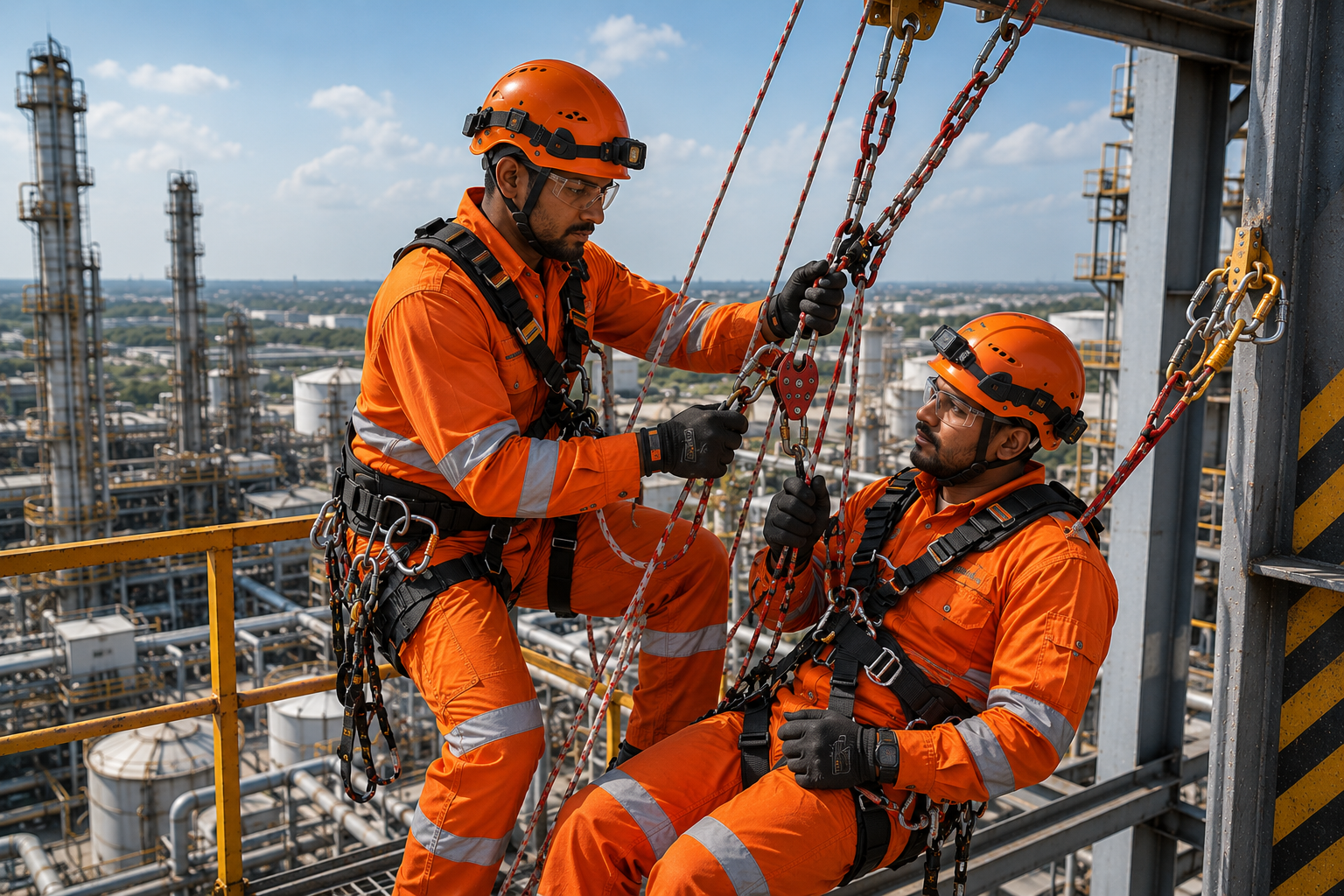
Falls from height remain the single largest cause of fatalities in India's construction and industrial sectors, accounting for a disproportionate share of fatal occupational accidents year after year. Yet the focus of most industrial safety programmes in India has been almost entirely on fall prevention — harnesses, guardrails, working platforms — with far less investment in what happens when prevention fails: the capability to rescue a worker who has fallen, become suspended, or is incapacitated at height. Rope rescue is that capability. It is a highly engineered, technically specialised discipline that bears almost no resemblance to the improvised ladder-and-rope responses that still characterise the emergency response at many Indian industrial sites.
Industrial rope rescue encompasses the full spectrum of high-angle and low-angle evacuation scenarios encountered across India's heavy industries: retrieving a suspended worker from a flare stack or cooling tower, evacuating an incapacitated person from scaffolding or a structural inspection platform, lowering a patient from the upper levels of a cement kiln building, or performing a cliff-face-style rescue from the exterior face of a power plant boiler. Each of these scenarios requires a different configuration of rope rescue system, and each requires rescuers who have been trained and assessed to a recognised competency standard — not rescuers who have attended a one-day working-at-height awareness course.
The Engineering Principles of Industrial Rope Rescue
A properly engineered rope rescue system is not a single piece of equipment — it is an integrated assembly of anchors, ropes, descent control devices, ascent devices, haul systems, and patient packaging components, each specified and connected according to established load calculations. The primary anchor must be capable of withstanding a minimum load factor of 15 kN (approximately 1,500 kg) for a rescue scenario involving a single rescuer and patient. In practice, Lifegear specifies and installs anchor systems with a minimum breaking strength of 22 kN in compliance with EN 795 and equivalent ITRA anchor standards.
The rope system itself distinguishes between the main line (used for load-bearing descent or ascent) and the belay line (an independent backup system that arrests the load in the event of main line failure). Both lines are specified to EN 1891 semi-static rope standards, with diameter, elongation, and sheath construction appropriate to the rescue application. Descent control devices — figure-eights, tube devices, or industrial autostop devices — are selected based on the load, the vertical distance, and the environmental conditions at the rescue site. Haul systems providing 3:1, 5:1, or 9:1 mechanical advantage are configured depending on the weight of the patient and the accessibility of the rescue point. This engineering is not optional — it is the structural foundation upon which rescuer and patient safety depends.
Equipment Standards and What Indian Plants Must Demand
One of the most significant and least addressed risks in Indian industrial rope rescue is the use of substandard or uncertified equipment. The rescue equipment market in India contains a substantial volume of products that are presented as rescue-grade but which do not comply with EN, NFPA, or ITRA equipment standards. Rope sold as rescue rope that does not meet EN 1891 specifications will elongate unpredictably under load. Descenders without EN 341 or EN 12841 certification may not hold a loaded rope under the forces generated during a rescue. Harnesses that are not EN 361 and EN 1497 compliant may fail under the dynamic loading of an unconscious patient.
For HSE managers and procurement heads specifying rope rescue equipment, the minimum requirements are unambiguous:
- Ropes: EN 1891 semi-static standards
- Anchor Devices: EN 795
- Descenders: EN 341 or EN 12841
- Harnesses: EN 361 and EN 1497
- Connecting Hardware: EN 362 (Carabiners, rigging plates)
Equipment must be inspected before every use by a competent person using a documented inspection checklist, with a formal annual inspection by a certified inspector and a mandatory retirement schedule based on manufacturer specifications and service history. Lifegear manages all of this through its RAP digital platform, which maintains a real-time inventory of every piece of rescue equipment at every contract site, with automated alerts for inspection dates, service intervals, and component retirement.
Rope Rescue Competency: Why ITRA is the Standard That Matters
In the global technical rescue community, ITRA certification is the recognised benchmark for rope rescue competency. ITRA's rope rescue curriculum is structured across three competency levels, from operational awareness at Level 1 through full technical proficiency at Level 3, with practical assessments conducted under realistic rescue scenarios by ITRA-accredited evaluators. The curriculum covers anchor construction, rope system rigging, patient packaging and litter management, high-angle lowering and raising operations, pick-off rescues from elevated structures, and multi-pitch operations. Critically, ITRA certification requires demonstrated practical proficiency — a rescuer cannot pass an ITRA assessment by answering questions correctly. They must perform correctly, under assessment conditions, in scenarios that simulate real rescue situations.
Lifegear is India's only rescue service provider whose deployed rescuers carry ITRA certification in rope rescue. This is not a marketing claim — it is a verifiable, documented qualification that any HSE manager or procurement head can request evidence of in a rescue service tender. Each Lifegear rope rescue team at a client site includes ITRA Level 2 and Level 3 certified technicians, with a certified Rescue Leader who holds the highest level of ITRA qualification. The teams are equipped with Lifegear's proprietary Quick Response Vehicles (QRV) — purpose-built rescue vehicles stocked with a complete rope rescue system, confined space kit, and medical response equipment — capable of mobilising to any rescue point within a plant complex within minutes of an incident alert. For any plant operating at height, this is the rescue standard your operations require.
References & Further Reading
- Lifegear Safetech: https://www.lifegear.in
- ITRA Rope Rescue Standards: https://www.technicalrescue.org/
Ready to Take Action?
- Contact Lifegear for a Live Demo of RAP (Rescue Application Platform) — www.lifegear.in
- Inquire About Rescue Contracts — Permanent, Shutdown & Turnaround Rescue Coverage Across India
- Learn More About ITRA Certification — www.technicalrescue.org