From Alarm to Action: How WhatsApp/Email API Alerts Cut Response Time
By Lifegear Team
2026-08-01
Introduction: Why Detection Alone Isn't Enough
Detecting a safety violation or emergency is only the first step in an effective response.
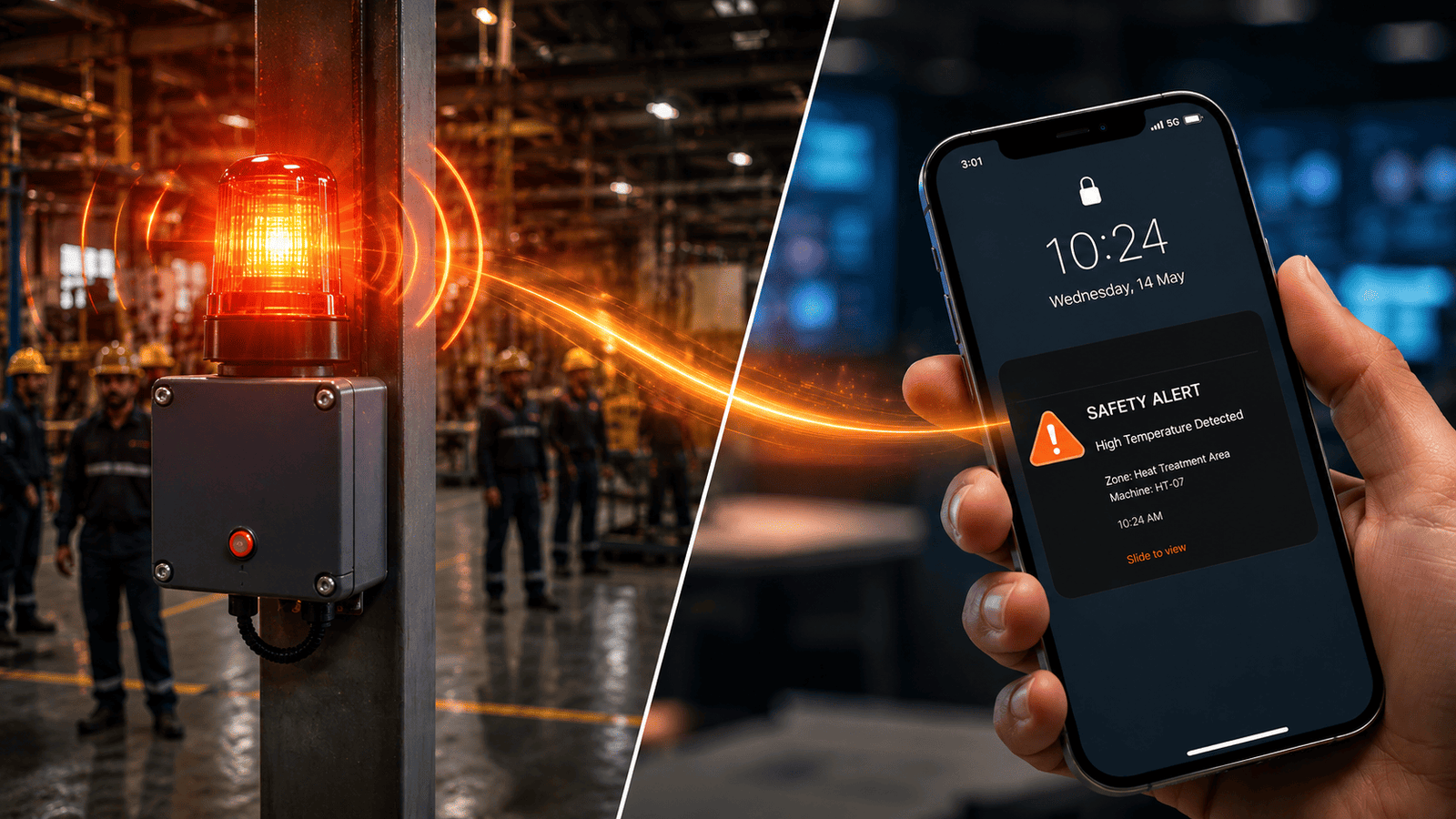
A local alarm can alert workers who are physically close to the incident, but industrial facilities often operate across multiple buildings, production zones, warehouses, and remote work areas. The people responsible for coordinating the response may not be standing anywhere near the alarm.
A shift-in-charge may be in another building. An HSE manager may be away from the immediate area. An emergency response team may be on standby elsewhere on the site.
This is where connected safety alerting becomes important.
Lifegear's RASU combines real-time detection with API integrations for WhatsApp, Email, and CMMS/ERP platforms, helping safety incidents reach the right stakeholders quickly and in a structured format.
1. The Problem With Alarms That Stop at the Site
Traditional alarms are designed to attract immediate attention within their physical range.
That works when someone is nearby. But large industrial facilities introduce a different challenge: physical distance.
An incident can occur in:
- A remote production area
- A warehouse
- A maintenance zone
- A separate plant building
- A contractor work area
- A temporary high-risk work zone
If the alert only reaches people within hearing or viewing distance, the escalation process can depend heavily on who happens to be nearby.
That creates a gap between incident detection and management awareness.
2. What RASU's API Alerting Actually Delivers
RASU extends safety monitoring beyond the local device by connecting detection events to digital communication channels.
When a violation or emergency is detected, the system can push relevant alerts through integrated platforms such as:
- CMMS platforms
- ERP systems
- Other connected enterprise applications
Instead of requiring someone to physically discover the alarm first, the incident can be communicated directly to designated stakeholders.
The alert can include important context such as:
- Incident type
- Location
- Timestamp
- Detection event
- Relevant response information
This gives recipients the information needed to understand what happened and where it happened.
3. Why Real-Time Notifications Matter
Every additional step between detection and notification can introduce delay.
Consider a simple sequence:
Incident → Local alarm → Someone notices → Someone informs supervisor → Supervisor escalates
Each step depends on human awareness and availability.
With connected API-based alerting, the process can become:
Incident → RASU detection → Digital alert → Responsible stakeholder
The objective is not simply to create another notification. It is to shorten the path between detection and informed response.
For facilities managing multiple areas simultaneously, this can make the escalation process more consistent.
4. From Local Alarm to Structured Escalation
A connected safety system can create a clearer escalation chain.
For example, a detected incident can be communicated to the appropriate people based on the facility's response process.
A possible workflow could look like:
Detection
RASU identifies a defined safety event.
↓
Local Intervention
The system provides an immediate on-site alert.
↓
Digital Notification
The event is pushed through WhatsApp or Email.
↓
Management Awareness
Relevant supervisors, HSE personnel, or response teams receive the incident information.
↓
Enterprise Record
Where integrated, the event can also be passed into CMMS/ERP workflows for tracking and follow-up.
This creates a connection between the physical safety environment and the organization's digital response processes.
5. Why Context Makes an Alert More Actionable
A notification saying only "Alarm triggered" provides limited information.
A structured alert can provide additional context that helps the recipient understand the situation before reaching the incident location.
Information such as where the incident occurred, what type of event was detected, and when it occurred can help the responsible person determine the appropriate next step.
This is particularly useful for large facilities where the recipient may be physically distant from the detection point.
The goal is simple: send the right information along with the alert.
6. Creating a More Auditable Safety Response
Safety management is not only about responding to incidents. It is also about understanding what happened afterward.
Connected digital alerts can help organizations move from isolated alarms toward a more structured incident trail.
When events are integrated with enterprise platforms such as CMMS or ERP systems, organizations can potentially connect detection events with their existing maintenance, response, or operational workflows.
This can support a more organized approach to:
- Incident tracking
- Escalation
- Follow-up actions
- Response documentation
- Safety performance review
Instead of an incident existing only as a sound or flashing light at the site, it can become part of a digital workflow.
7. Where API-Based Safety Alerts Make the Most Sense
Connected safety alerting can be particularly useful in environments where incidents may occur away from the people responsible for responding to them.
Examples include:
- Large manufacturing facilities
- Multi-building industrial sites
- Warehouses and logistics facilities
- Chemical and process plants
- Construction and project sites
- Maintenance and shutdown operations
- Facilities with distributed HSE teams
The larger and more distributed the operation, the more difficult it can be to rely entirely on physical proximity to alarms.
Conclusion
Detection is only half the job.
A safety system must also help ensure that the right people know about an incident and have enough information to respond.
Lifegear's RASU connects real-time safety detection with WhatsApp, Email, and CMMS/ERP integrations, helping transform isolated local alarms into structured digital escalation.
The result is a safety workflow designed around a simple principle:
Detect the incident. Alert locally. Notify the right people. Track the response.
When physical proximity can no longer be assumed, connected API-based alerting helps close the gap between detection and action.
Ready to Take Action?
Don't let critical safety alerts stop at the alarm.
- Connect real-time detection with digital notifications
- Extend safety alerts beyond the immediate work area
- Give responsible stakeholders incident context instantly
- Build a more structured and trackable escalation workflow
Close the gap between detection and response — contact Lifegear.
References & Further Reading
- Lifegear Safetech — RASU AI Safety Monitoring Platform
- Lifegear Safetech — Industrial Safety & Automation Solutions
- WhatsApp Business Platform — Messaging and API capabilities
- CMMS and ERP — Digital maintenance and enterprise workflow integration