Working at Height Safety Checklist for Indian Plants
By Lifegear Team
2026-11-09
Working at Height Safety Checklist for Indian Plants
Falls from height remain one of the most serious risks in Indian industry. They happen on roofs, structures, pipe racks, tanks, vehicles and scaffolds, often during routine jobs that people have done many times before.
A working at height safety checklist won't remove the risk by itself. What it does is make sure the same critical checks happen every time, whoever is supervising and however busy the day is. This guide gives you a practical checklist for before, during and after the task, including the one item many sites leave out: the rescue plan.
What counts as work at height?
Work at height means any work where a person could fall a distance that could cause injury. That includes:
- Working on roofs, platforms, structures and pipe racks.
- Working near an open edge, floor opening or skylight.
- Climbing ladders or working from mobile elevating work platforms.
- Standing on top of vehicles, tankers or large equipment.
- Working close to excavations or pits.
Different regulations and company standards set different height thresholds. Check the threshold in the rules and procedures that apply to your site, and remember that a fall from a lower height can still cause serious injury.
The order that matters: eliminate, prevent, arrest
Before choosing any equipment, work through this order:
- Eliminate the need to work at height. Can the task be done from the ground, with extended tools, or by lowering the equipment?
- Prevent a fall. Use guardrails, platforms, scaffolds or fall restraint so the worker cannot reach the fall hazard.
- Arrest a fall. Where a fall cannot be prevented, use a fall arrest system to stop it safely.
- Plan the rescue. If you rely on fall arrest, you must also plan how to get the worker down after a fall.
Fall arrest is the last line of defence, not the first. It should be chosen only after the higher options have been considered.
Pre-task checklist
Use this before every work at height task.
Planning and permits
- [ ] The task has been risk-assessed and the method agreed.
- [ ] A work at height permit has been issued and signed by the authorised person.
- [ ] Workers are trained and medically fit for work at height.
- [ ] Weather has been checked (wind, rain, lightning, extreme heat).
- [ ] Simultaneous work above or below has been identified and coordinated.
Access and the work area
- [ ] Safe access is in place: fixed ladder, scaffold, platform or MEWP.
- [ ] Scaffolds are inspected and tagged as safe for use.
- [ ] Fragile surfaces, such as skylights and roof sheets, are identified and protected.
- [ ] An exclusion zone is barricaded below the work area.
- [ ] Tools are tethered or contained to prevent dropped objects.
Anchors and fall protection equipment
- [ ] Anchor points are identified and suitable for the intended load.
- [ ] No improvised anchors, such as pipes, handrails or cable trays, are being used.
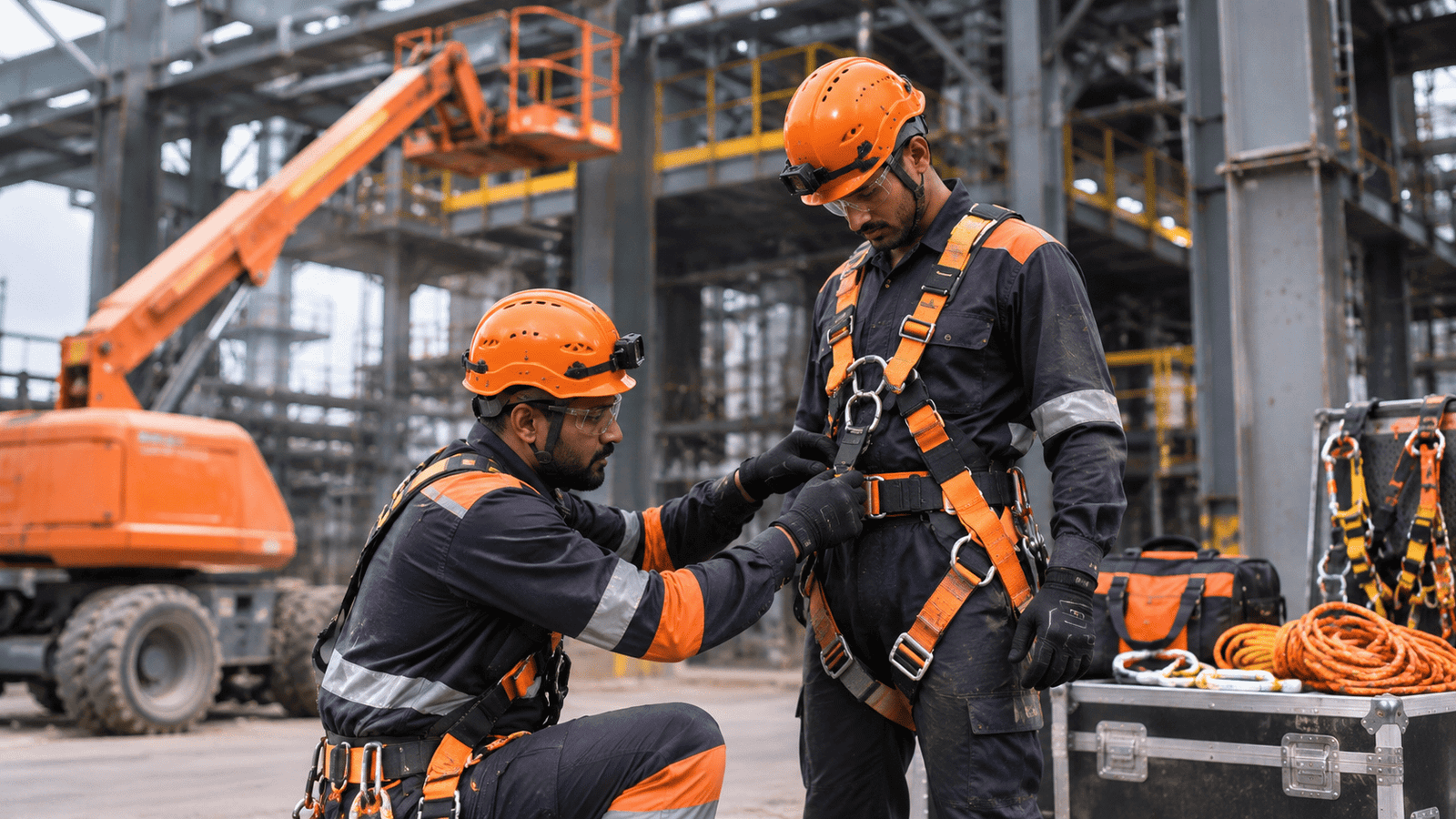
- [ ] Full body harnesses have been inspected before use and fit correctly.
- [ ] Lanyards, energy absorbers and self-retracting lifelines are inspected and in date.
- [ ] Connectors and carabiners lock correctly.
- [ ] Fall clearance below the worker has been checked.
Rescue
- [ ] A written rescue plan exists for this location and task.
- [ ] Rescue equipment is on site and ready.
- [ ] Trained rescuers are available and know their role.
- [ ] A way to raise the alarm has been agreed and tested.
During-task checklist
- [ ] Workers remain connected at all times when exposed to a fall (100% tie-off, for example with a twin lanyard).
- [ ] Anchors stay above the worker's back D-ring wherever possible, to reduce fall distance.
- [ ] The exclusion zone is maintained.
- [ ] The supervisor checks conditions regularly, including weather changes.
- [ ] Work stops if conditions change or equipment is damaged.
After the task
- [ ] Equipment is inspected, cleaned and stored correctly.
- [ ] Any damaged equipment is tagged and removed from service.
- [ ] The permit is closed out.
- [ ] Near misses and observations are reported.
The rescue plan belongs on the checklist
A fall arrest system stops a fall. It doesn't bring the worker down. A worker left hanging in a harness is still in danger, because prolonged suspension can cause serious harm, so the time it takes to reach them matters.
That is why every work at height checklist should ask one simple question before work starts: if this worker falls, who will bring them down, how, and how quickly? If nobody can answer it, the task is not ready to begin.
Indian regulatory context
In India, work at height is addressed through several laws and rules, including the Factories Act, 1948 and the state factory rules made under it, and the Building and Other Construction Workers (BOCW) Act, 1996 for construction work. Many industries also follow their own sector standards and company procedures.
Requirements vary by state and sector, so check the exact provisions that apply to your site with your safety and legal teams.
How Lifegear supports safe work at height
Lifegear designs and supplies engineered fall protection, including the Girafe series of portable anchor systems and horizontal and vertical lifeline systems for rooftops, crane bays, pipe bridges and loading areas. Where fall arrest is used, our standby height rescue teams provide the rescue capability the checklist calls for.
Our article on fall protection engineering and rescue services explains how prevention and rescue work together.
Frequently asked questions
What should a working at height checklist include?
It should cover planning and permits, safe access, protection of the work area, anchors and fall protection equipment, fall clearance, and a rescue plan. It should also include checks during and after the task.
Who should complete the working at height checklist?
Usually the supervisor or permit receiver completes it with the work team, and the permit issuer reviews it before authorising the work.
What is 100% tie-off?
100% tie-off means the worker stays connected to an anchor at all times while exposed to a fall, including while moving between anchor points. A twin-leg lanyard is commonly used for this.
Can a handrail be used as an anchor point?
Handrails, pipes and cable trays are not designed to take fall arrest loads unless they have been specifically assessed and approved for that purpose. Use a certified or engineered anchor instead.
Why is a rescue plan needed if workers wear harnesses?
A harness and lanyard stop the fall but leave the worker suspended. A rescue plan makes sure the worker can be reached and brought down quickly and safely.
Plan safer work at height with Lifegear
From portable anchors and lifeline systems to standby rescue teams, Lifegear helps Indian plants put every item on this checklist into practice. Contact us to discuss your site.